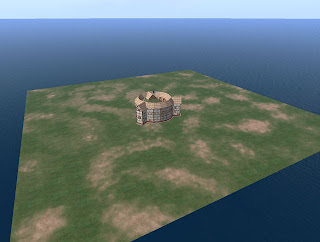
Last week we ran the SL/OpenSim activity for directing actors. The overall aim was for students to work in groups to plan out the stage direction for a piece of dialogue from Hamlet that only involved Hamlet and Ophelia, and then present their plan to the rest of the class. Virtual representations of the Globe theatre were used both as planning tools and the source of screenshots to use in their presentations.
There were 4 groups. At any one time only 1 group was in Second Life, and 1 was in OpenSim. They took it in turns, so ultimately 2 groups used OpenSim and 2 used Second Life.
The OpenSim setup is shown in the diagram below (the Second Life setup was identical, except that they connected to the Linden server instead of another PC in the room). Each group had 3 PCs, with two group members controlling the actors, and the remaining group members huddled around the 'director' PC. ((No it isn't the official Imprudence logo, but it's one of the variations that I prefer))

So how did it go? Put simply, very well. From the student experience point of view SL and OpenSim use was near-identical - one student did comment on OpenSim's tendency to flick the avatar's feet up to waist height occasionally. There were no crashes in either setup, and nothing noticeably weird happened. However a few general points did arise:
Getting to grips with SL
An issue that often arises in virtual world activities is the overhead in learners getting to grips with the technology. If anything we experienced the opposite effect. We bypassed all of the account creation/teleportation/inventory issues by providing ready-made avatars en-situ. Actors were on stage suitably dressed and the director was in the 'pit'. Actor controls were just the arrow keys to move around; the director controls were camera adjustment and screenshot taking. This wasn't enough for the students as they experimented with flying, text chat, and using gestures to act out parts of the dialogue.
It should be said that these were English Literature students, with a voiced aversion to 'techie' things. Some of the challenges experienced in introducing SL activities might be caused by exposure to too much early on. The group structure also provided peer support and allowed 'back-seat drivers'.
Phychomotor vs Affective learning
The activity was very successful in terms of students being able to use the technology as an assistance, rather than hindrance, in planning their stage direction. However, it seemed to be a less successful activity in terms of leading to an affective change in their understanding of Virtual World (VW) uses. There seemed to be a lack of imagination or extrapolation as to how VWs might be used in other areas.
This is probably a symptom of how the activity was designed. Removing distractions limited their view of the bigger picture. It's something that will be addressed in any future activities, but I'll wait to see what appears in the students' reflective journals before passing judgement.